
The road ahead for the Transformed Labour Force Survey

Today we have provided the latest evidence on progress towards using the Transformed Labour Force Survey (TLFS) for headline labour market statistics. The update covers the findings from our first readiness assessment, the further work needed before transition, and wider updates on assurance, accreditation and developments across our labour market statistics. Here, Liz McKeown and Alex Lambert reflect on what the update means for users, the route towards a likely transition in 2027 and the evidence and preparation needed to support it.
We use our labour market transformation updates to bring together evidence on progress across labour market statistics, including the development of the Transformed Labour Force Survey (TLFS). The latest update, published today, highlights an important milestone: the first TLFS readiness assessment. Conducted with key users in July, it brought together evidence from across the programme and helped us take stock of progress towards transition.
What did the readiness assessment tell us?
As expected, the readiness assessment confirmed that we are not ready to transition labour market statistics to being based on the TLFS now. We announced this likely conclusion in April 2026. It was nonetheless important to undertake this process as its real value was in helping us and our users build a clearer view of what still needs to be addressed, the evidence we need to gather and the route towards a safe transition in 2027, which remains the most likely path. The assessment also helped confirm that we need to wait for the final impact of recent design and method changes to feed through before we publish TLFS research outputs.
What needs to happen before transition?
Following this first readiness assessment, we wanted to set out the work we will be focusing on over the coming quarters and how it will help us address the issues raised through the readiness assessment and support a safe transition.
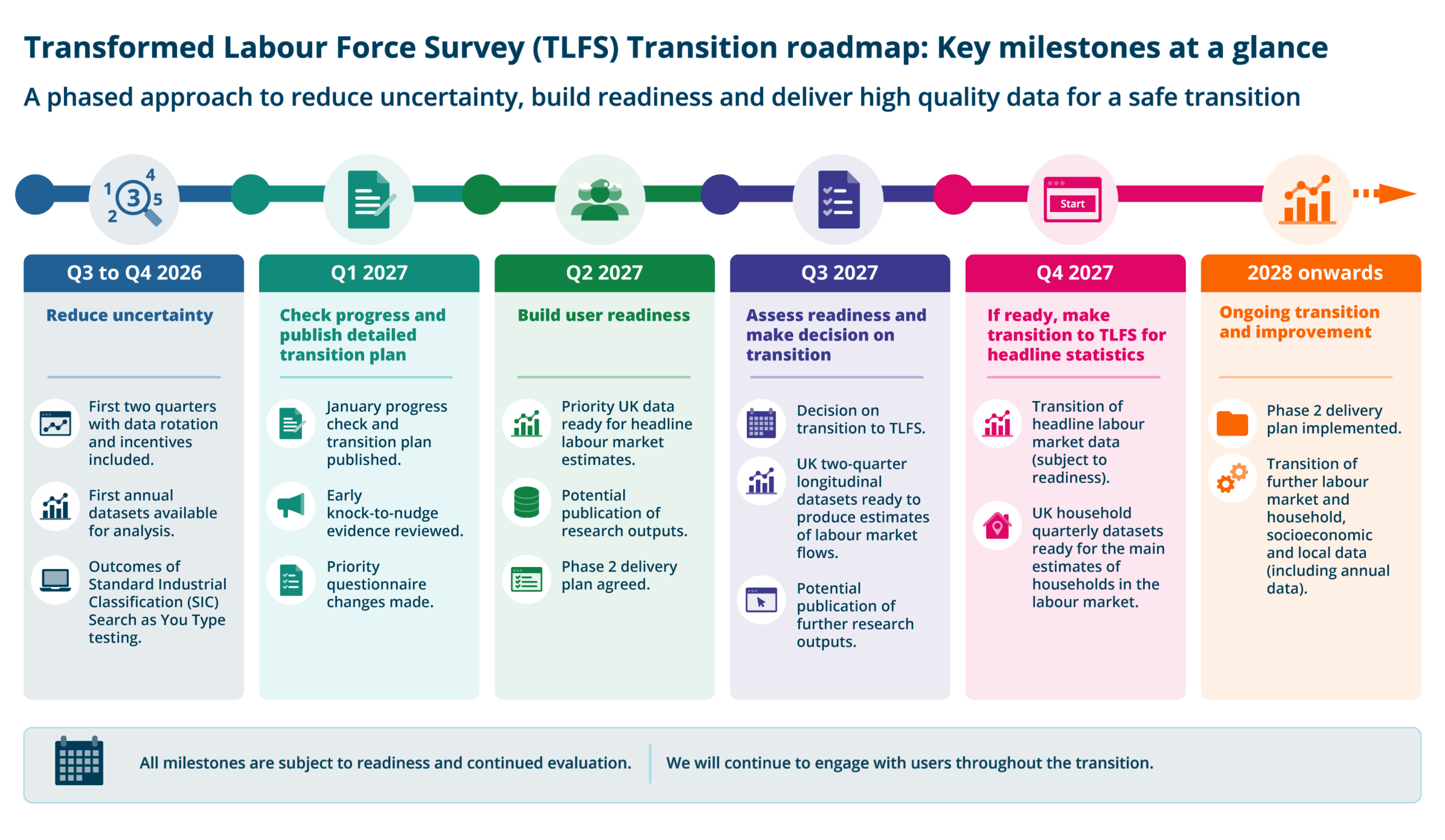
Transition Roadmap: Key milestones at a glance
Recent survey improvements introduced in April are showing encouraging early signs, including improved response and fewer partial returns. However, because the survey runs across multiple waves, more time is needed to understand the full impact of the recent changes and assess what they mean for the quality of the statistics.
Over the remainder of 2026 we will use the additional data becoming available to strengthen the evidence base on the impact of these changes and reduce uncertainty. We will also continue addressing the other issues identified through both the readiness assessment and our engagement with users. This includes industry and occupation data, UK-wide coherence and the wider household, socioeconomic and local statistics that many users rely on.
In January 2027, we will carry out a focused progress check on the programme and prepare a more detailed transition plan for publication later in that quarter. Throughout 2027, we want to give users the time and evidence they need to understand the new data, assess its impact on their own analysis and prepare for the move to the TLFS.
The next major milestone is expected in July 2027, when we plan to undertake a further full readiness assessment. If the evidence supports it, and if we and our users are ready, we will make the transition to the TLFS for our headline labour market statistics in November 2027. However, the decision will remain evidence based, with quality, user confidence and the growing constraints of running the LFS and TLFS in parallel all taken into account. Running the two surveys side-by-side affects the quality of both surveys and, given resource constraints, wider statistics produced by the ONS. Continuing the parallel run into 2027 also has cost implications which will need to be managed.
It is also important to be clear that transition would be a process rather than a single endpoint. Moving our headline statistics to being based on the TLFS would allow us to end the parallel running of the LFS and TLFS, but it would not mark the end of development of the TLFS. Stopping the LFS will release resources and improve TLFS operations. As more data become available, and as we continue to consider how survey and administrative data can best support labour market statistics, we expect to continue refining methods, improving quality and strengthening the wider range of outputs supported by the survey.
What wider updates did we cover?
The update also reflects on the LFS operational issue identified earlier this year, which led to temporary under-resourcing in LFS telephone collection operations, resulting in fewer achieved household interviews than expected during this period. It occurred due to a combination of operational changes and pressures which created a mismatch between operational demand and available interviewer capacity. The issue underlined the complexities of running two of the largest household surveys in the country in parallel.
As set out in the LFS quality article last month, our analysis indicated that the impact on headline estimates was minimal, though there were small but noticeable effects on average hours and total hours worked estimates. Even where the impact is limited, issues like this matter, and we have looked carefully at what happened and what needed to change. We have since undertaken a lessons learned exercise, supported by independent external challenge, and implemented immediate improvements to our telephone operations. We are now considering the broader lessons for our other survey operations and will report on both the lessons learned and our response to it in the next Surveys and Economic Statistics Improvement Plan quarterly update in October.
The issue was separate from decisions about the future transition to the TLFS, but it has reinforced a wider point for us: the quality of labour market statistics depends on the social survey operations that underpin them. That is why strong assurance, close scrutiny of real-time performance information and clear escalation are central to how we manage change across survey operations.
Our proposed approach to the designation of outputs
Separately we have also written to the Office for Statistics Regulation (OSR) about the designation and accreditation of outputs based on the LFS and Annual Population Survey (APS). We are proposing that LFS and APS-derived outputs that are currently official statistics in development will move to official statistics and we will not be seeking reaccreditation. Instead, our priority is for outputs based on the TLFS, as the online-first sustainable replacement for the LFS and APS, to achieve the standards required to become accredited official statistics and for OSR to consider their accreditation at the earliest opportunity.
What should users take from this update?
There is still important work to do before labour market statistics can move to being based on the TLFS and we do not underestimate that. But the readiness assessment has provided greater clarity about the route ahead to transitioning in 2027, the decisions that remain and the evidence we still need to gather. The lessons from the LFS operational issue have reinforced the importance of strong assurance ahead of making operational changes, as well as interrogation of, and learning from, real-time management information across both our social survey operations and the statistics they support.
Progress towards transition has benefited greatly from the input of the Stakeholder Advisory Panel on Labour Market Statistics, technical experts and other users. We are grateful for the time, expertise and constructive challenge they continue to provide, which helps us identify risks, test assumptions and strengthen our plans for transition.
As we continue this work, we will publish regular updates and engage closely with users, remaining open about both the progress we are making and the challenges we are facing. We welcome ongoing feedback at: labour.market.transformation@ons.gov.uk.

Liz McKeown is Director of Economic Statistics at the Office for National Statistics.

Alex Lambert – Director of Social Surveys at the Office for National Statistics