
Net migration continues to fall

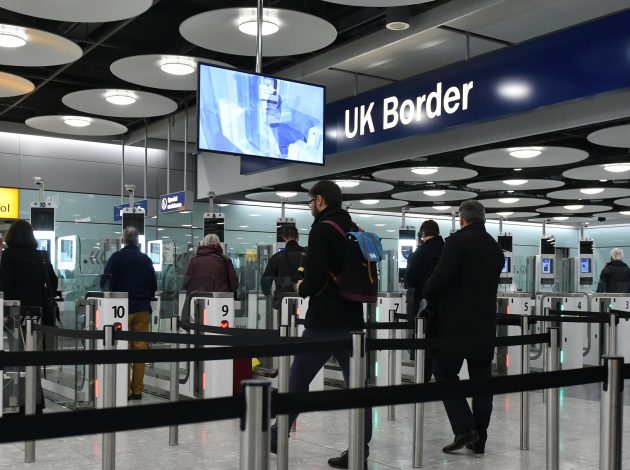
Annual international net migration is down by three-quarters of a million people since its peak in early 2023. In today’s blog, Sarah Crofts looks at what is driving this change, explores patterns of British migration and looks ahead to future developments that will give a clearer picture of emigration.
UK long term international net migration – people who move country for one year or more – continues to fall and is at levels last seen in early 2021 when the new immigration system was introduced and Covid-19 travel restrictions were still in place.
Our provisional estimates show that in the year ending (YE) December 2025 overall net migration stood at 171,000 – down from 331,000 a year earlier. A fall in non-EU immigration is the main driver of this.
Overall, non-EU net migration has fallen by two-thirds since it peaked in 2023. In the most recent period, the number of people from outside the EU arriving for work-related reasons almost halved and is the main factor behind the continued fall in net migration.
Meanwhile, both British and EU net migration is negative – this means more people have left the country than arrived in the past 12 months. The trend among British nationals is broadly stable, while net migration for the EU nationals has been negative since 2022.
While emigration had been increasing since 2022, there are early signs it may now be starting to fall, though it is too soon to say whether this will continue. The fall in the past 12 months is mainly due to a decrease in EU nationals leaving, while the rate of non-EU emigration has slowed.
Better understanding British migration
Our November 2025 release of long-term international migration estimates prompted speculation about whether record numbers of British people were leaving the UK. However, this was due to changes in the way we estimate British nationals moving into and out of the UK, which made a previously incomplete picture more accurate. In fact, looking at recent trends since 2021 using our new methods, the number of British nationals leaving the country (and coming to the country) has been fairly stable.
Our new method uses Department for Work and Pensions records to check when British nationals start or stop interacting with the tax, benefits or education system, to estimate arrivals to and exits from the UK. This replaced the International Passenger Survey we’d historically used and had long said was stretched beyond its original purpose. In November we revised our existing time series back to June 2021 using the new method. This has an impact on both immigration and emigration figures, and we now have a clearer idea of the number of British people who have migrated each year.
There’s also been a lot of focus on young Brits leaving the country. However, around the world, people who move countries do mostly tend to be young as they move for study or work-related reasons. This is as much the case for non-EU and EU nationals moving to the UK, as it is for British nationals leaving the UK. We have now published age and sex breakdowns of British migration back to 2022 which show there has been no real change in behaviours over this period.
Today we’ve also published an explainer article which looks in more detail at recent trends of British migration and explores what we know about where Brits go when they leave the UK.
Future developments
We’ve made significant improvements to our migration estimates over recent years, making the switch from survey data to administrative data held by government. However, we are always developing our statistics, exploring the potential of new data sources and methods.
One area of focus highlighted in our recent research update is emigration. For most EU and non-EU visa holders, we can see a final departure record in the administrative data we use. For a small number a departure record might not be present and for most of those we assume they have left at the end of their visa.
A departure may be missing because it is not matched against an arrival by the system; the person has died; the departure was via the Common Travel Area; or dual nationals have used different documentation to enter and leave the UK.
We are researching two groups that do not have a final departure in the data.
These groups are those who have made a new in-country visa application after their previous visa expired and therefore have permission to stay in the country via what is known as 3C leave, and those who have overstayed their visa.
On the first group, we have been learning more about the indicators of 3C leave in the Home Office admin data and using this to improve our existing methods, which we’ve incorporated into our latest release.
Our future emigration work is therefore focusing on the second group – better understanding those with no departure record who could include people who have overstayed the duration of their visa. Determining who is an overstayer is challenging. This is because of all the reasons previously discussed why a departure might not be in the available data and why some migrants can come to the end of their visa and be legally in the UK.
We are trying to evaluate if a missing departure is because of missing data or a genuine non-departure. It’s complex but we’re working closely with the Home Office to provide an update on this later this year.
As ever, if you have any feedback or questions, please contact us via email at pop.info@ons.gov.uk

Sarah Crofts is Deputy Director of Migration Statistics