
Introducing new figures on fathers’ fertility and families
For almost two centuries detailed data on childbearing by mothers has been produced. However, until now, completing that fertility picture with data on fathers has been more challenging. Here Greg Ceely explains why a change in legislation in 1960, and the subsequent digitisation of births data, means the ONS is now able to provide fresh insights on fathers over a lifetime.
One of the oldest records we have at the Office for National Statistics (ONS) is our childbearing data, which documents the number of births all the way back to 1838. This tells us all sorts of important and interesting information, ranging from how the number of children being born fluctuated over world wars and economic crises, to the shifting age of mothers, and even how names have changed in popularity over the last century.
Despite this wealth of data, these records have told us much less about fathers and male fertility. The result has been an incomplete picture of the nation’s fertility However, now we have several decades of consistent recording of fathers, we are finally able to fill in at least some of these gaps.
Much ado about mothers
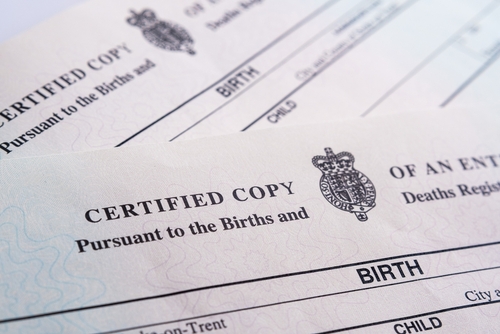
Since 1837, live births in the UK have had to be registered and it is from these registrations that we get our figures. However, these earliest registrations ask fewer questions about fathers – in fact, it wasn’t until 1961, following the Population Statistics Act of the previous year, that the age of father started being recorded.
Even so, when looking at where fathers have been recorded, age is only included if it’s within a marriage, civil partnership, or jointly registered. Birth registrations are typically completed by mothers, who are able to register a birth without providing information about the father.
The result is that records on fathers are missing in a small proportion of births (for instance, they were missing in 4.5% of births in 2024 that were sole registrations), and even in joint registrations there is less information about the father. As a result of this, until now we have only been able to publish “snapshots” of male fertility based on a year’s registrations, such as the average age of fathers that year (33.9 in 2024). Producing the long-term picture of fertility over a father’s entire lifetime required data that simply wasn’t there. This included how many previous children a father has had, what proportion of men had fathered a child, the number of children a man might have over their lifetime, and the number of children born to men of different ages.
Improving the picture for men
Following user feedback, we have set out to provide a better picture of fathers. For the first time, we’ve been able to start producing cohort-based fertility tables for men, similar to those long produced for women. These count the average number of children fathered by a cohort of men (i.e. men born in a certain year) over their reproductive lifetime.
This is done by using digitised birth registration data, which is available from 1964 onwards, combined with population estimates. Together, this allows us to construct longitudinal fertility profiles for men in much the same way as has been done for women. However, this was only the first step. As mentioned above, data on the father’s age, which is a key number for calculating these longitudinal profiles, can also be missing.
As such, we have combined this with imputing these missing values using observed age distributions from jointly registered births. Specifically, for each age of mother, a corresponding distribution of fathers’ ages is calculated and then applied to sole registrations, ensuring that the estimates remain representative. We continued to study this for a longer age range for men, calculating fertility up to age 65 versus age 45 for mothers, to reflect the longer period men can have children for.
First findings and future fertility work
All of this work now allows us to create new types of statistics for men: cumulative fertility measures (showing the average number of children fathered by a given age) and age-specific fertility rates (showing fertility patterns at each age). We have published these new figures in our latest statistical bulletin on fertility covering a complete set of information for men born between 1949 and 1959 (who are in their 60s and 70s). These are statistics in development and we intend to build on these tables by adding an additional year of data each time we publish a new release.
The first set of data focuses on men born in 1959, who will be the most recent group to have finished building their family by 2024. This new data reveals several interesting things about male fertility, most notably that family size for men is lower than for women of the same age. This is because men tend to have children at older ages compared with women. The age by which there was an average of one child per man was 31 years for men born in 1959, compared with 28 years for women of that year.
We’ve long documented how mothers are having children later in life. We can now show this trend is also true of fathers. For men born in 1979, the age at which there was one child per man had risen to 33 (for women born that year it had also risen, up to age 31). However, despite men having children later, by the time they have finished their family it is of a similar size to women’s, with fathers born in 1959 having 2.00 children, compared with 1.98 children in the completed family of a mother born that year.
Despite these interesting findings, some limitations remain. We’re unable to estimate the proportion of men who don’t father children or the average age a father has their first child, as the necessary information is just not recorded in birth registrations. However, we can now provide a more complete and nuanced picture of male fertility trends than was previously possible.

Greg Ceely is Head of Population Life Events at the Office for National Statistics